
Exposing hidden high-affinity states
Bayesian NMR analysis of a six-state thermodynamic model shows that TAR's highest-affinity conformation is essentially undetectable in the free RNA — hiding nanomolar binding behind a large conformational penalty.
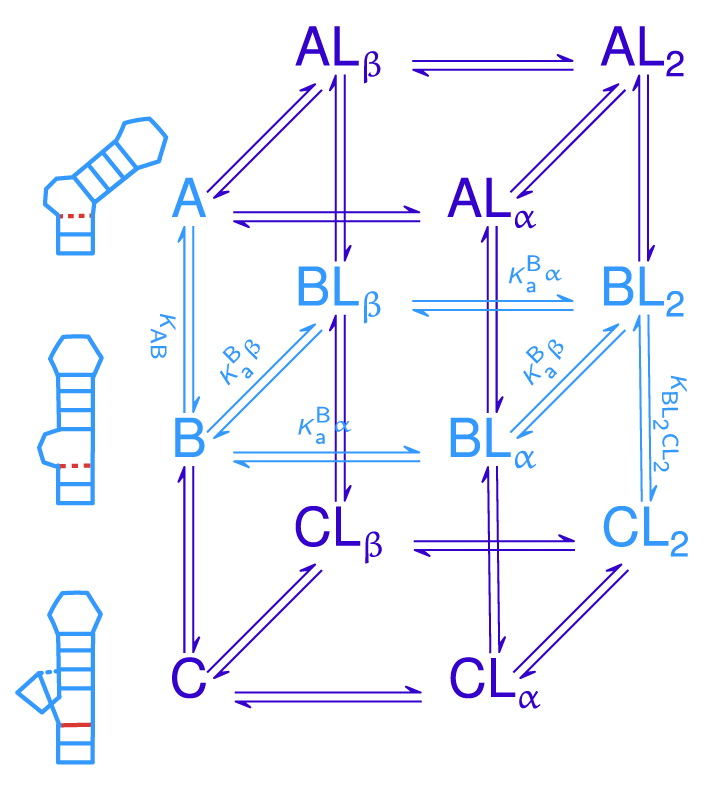
THE CHALLENGE
An invisible state doing the binding
HIV-1 TAR is a small, flexible RNA that interconverts among conformations. The one that binds ligands most tightly is barely populated in the free RNA — so an equilibrium binding measurement reports an affinity that's an average over the ensemble, badly underestimating what the high-affinity state can actually do.
To target TAR rationally, you need the affinity and population of a state you can't directly see.
WHAT WE DID
Let the data constrain the hidden states
We cast TAR as a six-state thermodynamic model and fit it to the NMR observables within a Bayesian framework — inferring not just point estimates but full posterior distributions over each state's population and binding affinity. The Bayesian treatment is essential here: it propagates the uncertainty from a sparsely-populated state honestly, rather than reporting an overconfident single number.
The result is a credible-interval picture of states the spectra only touch indirectly.
WHAT IT REVEALED
Nanomolar binding behind a conformational penalty
The analysis unmasked a high-affinity conformation with nanomolar binding that is almost absent in the free RNA — its apparent weakness is a conformational penalty, the free-energy cost of reaching the binding-competent state, not poor intrinsic affinity. Separating those two contributions reframes what a TAR-targeting ligand actually has to overcome, and where the design leverage really is.
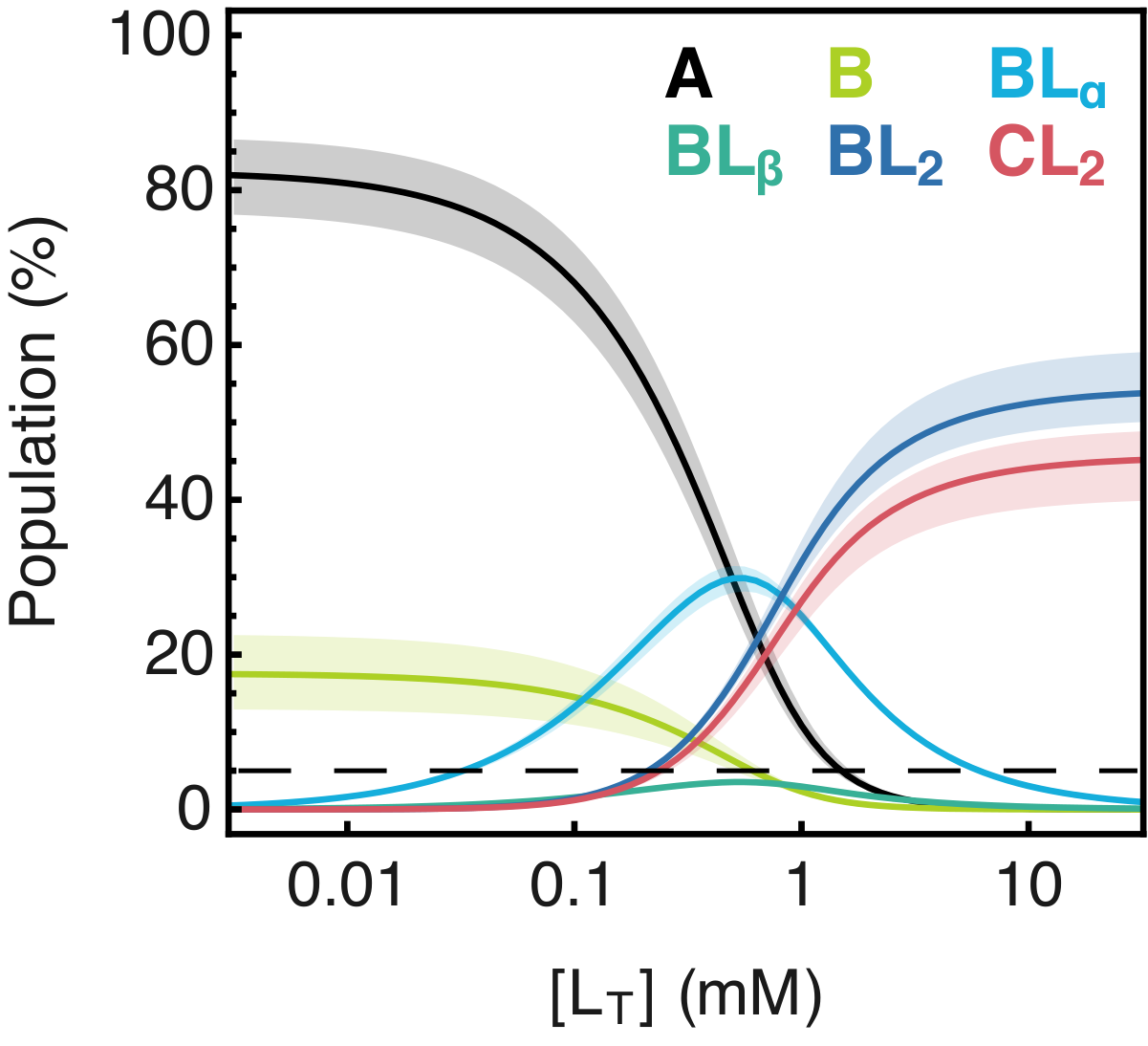
The affinity was always there — it was the population that hid it. Tell those apart and the design problem changes.
Conformational change coupled to ligand binding
A 10-state model resolving conformational selection and induced fit — operating together near the apparent Kd.
Read case study →Antibody-binding domains fold independently
A steep N-to-C stability gradient across five independently folding domains.
Read case study →Have a system like this?
Tell us about the molecule, the data, and the question. We'll tell you whether a thermodynamic model can answer it.
Contact Us→